Wellness Retreat Guide: The 2026 Strategic Editorial Pillar
The modern preoccupation with wellness has matured from a niche subculture into a complex, multi-trillion-dollar global economy. As individuals grapple with the compounding effects of chronic sympathetic nervous system arousal—the byproduct of an increasingly digitized and high-velocity professional existence—the “retreat” has emerged as a critical intervention. This is not merely an exercise in escapism; it is a calculated effort to manipulate one’s environment to facilitate physiological and psychological recalibration. However, as the market saturates with diverse offerings ranging from clinical longevity centers to rustic silence-based ashrams, the ability to discern high-fidelity experiences from superficial marketing becomes a requisite skill for the serious practitioner.
A retreat functions as a “controlled environment,” a temporary container where the variables of daily life—diet, social obligation, sensory input, and movement—are deliberately adjusted. When executed with precision, this immersion triggers a cascade of neurobiological shifts: a reduction in baseline cortisol, an increase in heart rate variability (HRV), and a “re-tuning” of the master circadian clock. Conversely, a poorly selected retreat can inadvertently introduce new stressors, such as travel fatigue, dietary shock, or social anxiety, thereby negating the intended benefits and resulting in what is known as “recovery debt.“
The task of navigating this landscape requires an analytical framework that moves beyond the aesthetic allure of infinity pools or minimalist architecture. It demands an understanding of the underlying “Curriculum of Care”—the specific methodology an institution employs to move a guest from a state of depletion to one of resilience. This document serves as an authoritative audit of the contemporary immersion landscape, providing a rigorous structural analysis for those who view wellness not as a luxury but as a fundamental component of cognitive and biological maintenance.
Understanding “Wellness Retreat Guide”
To engage with a wellness retreat guide is to engage with the science of “Environmental Design.” A fundamental misunderstanding in this space is the conflation of a retreat with a vacation. While a vacation focuses on indulgence and the temporary suspension of responsibility, a wellness retreat focuses on the “Optimization of Function.” This distinction is critical because the former often leaves a participant “vaca-tired”—depleted by a lack of routine—whereas the latter utilizes a highly structured schedule to restore internal order.

Multi-perspective analysis suggests that the efficacy of a retreat is often inversely proportional to its “Choice Density.” In a standard travel scenario, the constant need to make decisions—where to eat, what to do, how to navigate—consumes significant cognitive energy. A high-integrity wellness retreat removes this “Decision Fatigue” by providing a set protocol. This allows the prefrontal cortex to rest, shifting the brain’s energy toward interoception and deep recovery. Oversimplification in this field often leads to “The Aesthetic Trap,” where consumers prioritize the visual tranquility of a location over the qualifications of the facilitators or the rigor of the nutritional programming.
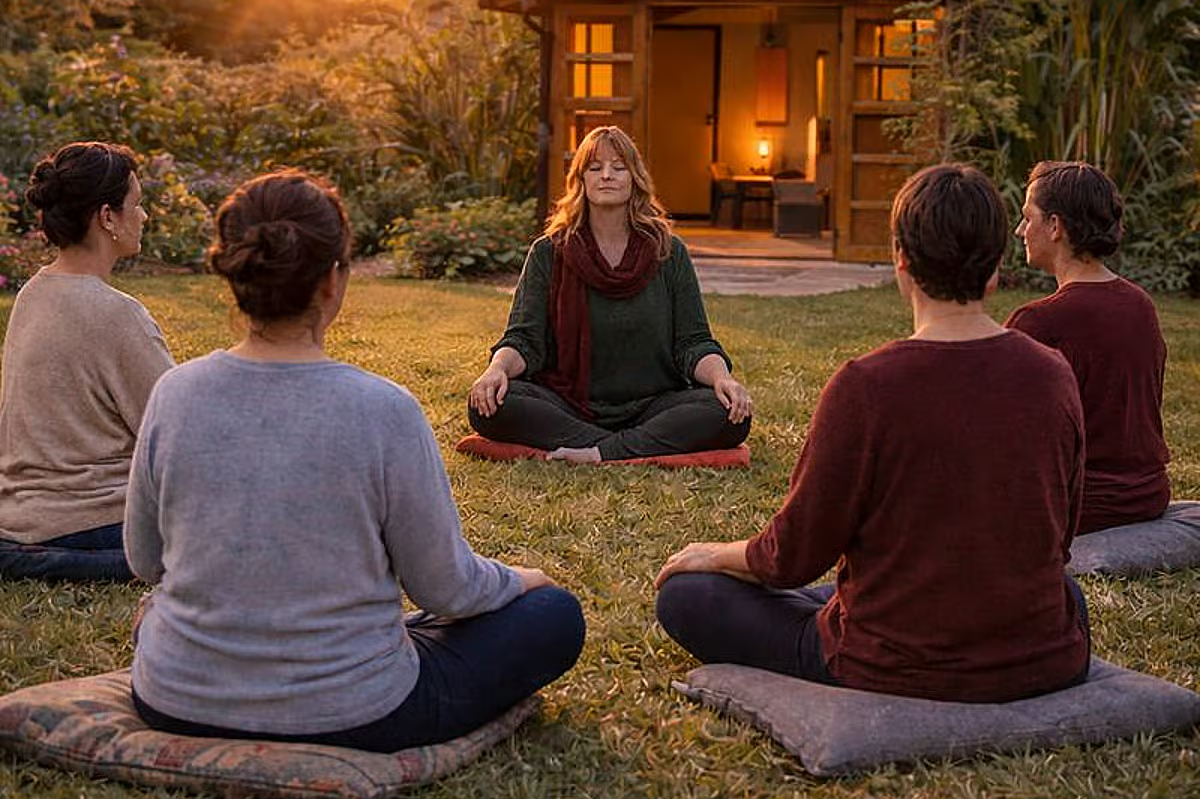
Furthermore, we must recognize the role of “Social Architecture” in these environments. A retreat can be a “Solitary Immersion,” designed for internal dialogue and silence, or a “Communal Cocoon,” designed for collective regulation and shared vulnerability. A mismatch between a participant’s current psychological state and the social structure of the retreat is a primary driver of unsatisfactory outcomes. For instance, an individual suffering from social burnout who selects a communal, high-interaction workshop may leave more depleted than they arrived.
Contextual Background: The Evolution of the Sanctuary
The historical trajectory of the retreat can be traced from sacred monastic traditions to the “Sanatorium Movement” of the 19th century. In Europe and the United States, mineral springs and mountain air were treated as medical prescriptions for the “neurasthenia” of the industrial age. These institutions were characterized by strict discipline: early wake-up calls, cold water hydrotherapy, and “Clean Living” diets. This was the first iteration of wellness as a disciplined, clinical intervention.
The late 20th century saw the “Wellness Revolution” in California, which shifted the focus toward psychology, movement, and Eastern philosophies. This era democratized the retreat, moving it away from the medical and the monastic into the lifestyle sector. By the early 2010s, wellness had become a status symbol, leading to the rise of “Wellness Tourism,” where the focus shifted toward luxury, aesthetics, and social signaling.
In 2026, we are witnessing a “Return to Rigor.” As the novelty of spa treatments has faded, it has been replaced by a demand for “Evidence-Based Immersion.” Modern participants are seeking quantifiable results: blood marker improvements, sleep architecture optimization, and neuro-resilience training. The contemporary sanctuary is no longer just a place to relax; it is a “Bio-Optimization Lab” that integrates ancient contemplative technologies with modern medical diagnostics.
Conceptual Frameworks and Mental Models for Selection
1. The “Hormetic Sweet Spot” Model
This framework evaluates a retreat based on the amount of “Positive Stress” it applies.
-
Mechanism: True growth requires a challenge (fasting, heat, cold, silence, or intense movement).
-
Evaluation: If a retreat provides no challenge, it is likely a vacation. If it provides too much challenge (e.g., an 18-hour-a-day meditation schedule for a beginner), it becomes a trauma. The goal is “Hormesis”—stress that triggers a beneficial adaptive response.
2. The “Biological Anchor” Framework
Assesses how well a retreat aligns with circadian rhythms.
-
Mechanism: Does the location provide “Early Morning Blue Light” and “Evening Red Light”? Is the food served during daylight hours?
-
Limit: A retreat in a high-rise city hotel with artificial lighting fails this framework, regardless of how good the yoga classes are.
3. The “Transferability” Mental Model
Asks the question: “Will the benefits survive the airport?“
-
Focus: Does the retreat teach a skill (e.g., a specific breathing technique or a way of eating) or does it merely provide a service (e.g., a massage)?
-
Action: Prioritize “Education-Heavy” retreats over “Service-Heavy” ones for long-term ROI.
Taxonomy of Immersive Modalities: Categories and Trade-offs
A comprehensive wellness retreat guide must categorize these experiences by their primary “Biological Lever.“
| Modality | Primary Goal | Physical Intensity | Trade-off |
| Medical/Longevity | Diagnostic/Bio-hacking | Moderate | High cost; clinical atmosphere |
| Silence/Contemplative | Neurological reset | Low | High “Boredom Shock” for beginners |
| Fitness/Movement | Metabolic flexibility | High | Potential for “Over-training” injury |
| Nature/Eco-Immersion | Parasympathetic activation | Variable | Limited modern amenities/exposure |
| Nutritional/Detox | Gut microbiome reset | Low | Temporary irritability/Headaches |
| Emotional/Therapeutic | Psychological processing | Low | Requires high vulnerability |
Decision Logic: The “Dominant Deficiency” Audit
When selecting a retreat, one should audit their “Dominant Deficiency.” Are you physically stagnant but mentally sharp? A Fitness retreat is your counterweight. Are you mentally frayed but physically active? A Silence-based retreat is the objective requirement.
Real-World Scenarios and Decision Logic
Scenario 1: The “Burnout” Recovery
-
Context: A high-level executive with chronic insomnia and elevated blood pressure.
-
Decision: Avoid “Bootcamp” style retreats. The sympathetic system is already overtaxed. Choosing a “Nature-Immersive” silent retreat in the Pacific Northwest—focusing on forest bathing and circadian light—provides the necessary “Vagal Tone” reset.
-
Failure Mode: Selecting a high-intensity fitness retreat that causes a “Rebound Crash” upon returning to work.
Scenario 2: The “Metabolic Rebound”
-
Context: An individual struggling with blood sugar regulation and “Brain Fog.“
-
Decision: A 7-day nutritional retreat in a Mediterranean climate that emphasizes “Intermittent Fasting” and “Whole-Foods, Low-Glycemic” education.
-
Second-Order Effect: The participant learns the “Satiety Cues” necessary to maintain the habit in a chaotic urban environment.
Economics of Investment: Direct and Opportunity Costs
The cost of a retreat is often analyzed through a narrow lens of tuition and airfare. However, a senior-level analysis accounts for the “Opportunity Cost of Depletion.“
| Tier | Weekly Cost (USD) | Resource Intensity | Long-Term Value |
| Boutique/Luxury | $8,000 – $15,000 | High financial | Immediate comfort; low habit-sticking |
| Specialized/Clinical | $4,000 – $7,000 | Moderate financial | High diagnostic data; lifestyle shift |
| Traditional/Ashram | $700 – $1,500 | High “Willpower” cost | Maximum neurological durable change |
The Hidden Cost of “Cheap” Wellness: Choosing a low-cost retreat in a noisy, polluted area to save money is a “False Economy.” The lack of environmental control means the brain never enters the “Alpha/Theta” states required for genuine repair, essentially turning the retreat into an expensive, mediocre vacation.
Strategic Support Systems for Pre- and Post-Immersion
A retreat is not a 7-day event; it is a 21-day “Arc of Transformation.“
-
The “Downward Glide” (3-5 days pre-retreat): Gradual removal of caffeine, alcohol, and high-intensity digital stimulation. This prevents “Day 1 Withdrawal Syndrome,” where the first two days of the retreat are lost to headaches and irritability.
-
The “Analog Buffer” (Arrival day): Turning off the phone 2 hours before arriving at the center to allow the “Salience Network” to begin its shift.
-
The “Micro-Habit Anchor”: Identifying one specific physical cue from the retreat (e.g., a specific scent or morning stretching sequence) to replicate at home.
-
The “Social Re-entry” Plan: Committing to 48 hours of limited social engagement after returning home. “Re-entry Shock” is a common failure mode where the newly found tranquility is immediately shattered by a chaotic social calendar.
-
The “Digital Firewall”: Setting an “Out of Office” that extends two days past the actual return date to allow for integration.
Risk Landscape: Identifying Failure Modes
Even with a high-quality wellness retreat guide, several “Compounding Risks” can compromise the experience:
-
The “Guru” Dependency: Retreats that center on the charisma of a single leader rather than a replicable methodology. This creates a “Spiritual High” that crashes as soon as the leader is absent.
-
Environmental Volatility: Choosing a retreat in a region prone to “Seasonal Noise” (e.g., peak tourist season or construction). Silence is the most expensive and fragile component of a retreat.
-
Nutritional “Aggression”: Sudden, radical dietary shifts (e.g., going from a standard diet to a “Juice Fast”) can trigger an acute “Detox Reaction” that makes practice impossible.
-
Psychological “Flooding”: Intensive emotional retreats can bring up suppressed trauma. If the facilitators are not clinically trained to provide “Containment,” the participant may leave in a state of hyper-arousal.
Governance and Post-Retreat Integration Protocols
The true measure of a retreat is its “Half-Life”—how long the benefits last once you return to the “Default World.” To maintain the “Governance” of your newly acquired state:
-
Monitoring: Use a wearable to track HRV and Deep Sleep. If these markers return to pre-retreat baselines within 14 days, the integration has failed.
-
Adjustment Triggers: If your “Stress Reactivity” (how you respond to a late train or a rude email) returns to 100%, it is a signal that your “Micro-Dose” of daily practice needs to be increased.
-
The Layered Checklist for Continued Maintenance:
-
The “Sunlight First” Rule: 10 minutes of outdoor light within 30 minutes of waking.
-
The “Movement Minimum”: 20 minutes of zone-2 cardio or yoga daily.
-
The “Digital Sunset”: No screens after 9:00 PM to protect the newly tuned melatonin cycle.
-
Measurement, Tracking, and Evaluation of Success
A successful immersion should be evaluated using both “Leading” and “Lagging” indicators.
-
Leading Indicator (During the retreat): “The Arrival of Boredom.” In the first 48 hours, the brain often fights the lack of stimulation. The moment boredom is replaced by “Alert Stillness,” the retreat has successfully breached the “Noise Barrier.“
-
Lagging Indicator (30 days post-retreat): “The Reactivity Gap.” The measurable space between a stressful stimulus and your response. If you find yourself “Choosing” your response rather than “Reacting” reflexively, the neurological wiring has changed.
-
Documentation Example: Keeping a “State-Log” for the first week back, noting instances of “Flow State” versus “Agitation.“
Common Misconceptions and Myths
-
Myth: “I can do a retreat at home for free.“
-
Correction: While possible, the “Willpower Cost” of ignoring the doorbell, the laundry, and the smartphone is so high that most people never enter the “Deep States” accessible in a dedicated facility.
-
Myth: “The more expensive the retreat, the better the result.“
-
Correction: Luxury often provides “Comfort,” which can actually dull the hormetic stress needed for growth. Some of the most profound changes happen in Spartan, low-cost monastic environments.
-
Myth: “A retreat will fix my life in a week.“
-
Correction: A retreat provides a “Reference State”—a glimpse of how good you can feel. The “Fix” is the discipline of integration that follows.
-
Myth: “You need to be in good shape to go to a wellness retreat.“
-
Correction: Wellness retreats are for the “Un-well.” Waiting to get fit before attending a fitness retreat is like waiting to get healthy before going to a doctor.
Conclusion: The Strategic Imperative of the Retreat
In an era defined by “Information Overload” and “Biological Misalignment,” the intentional retreat has transitioned from a fringe indulgence to a strategic imperative. By understanding the mechanics of “Environmental Design” and the neurobiology of recovery, the participant can move beyond the “Consumer” model of wellness and into a “Practitioner” model. The goal is not to live in a perpetual state of retreat, but to use these concentrated doses of silence, movement, and nutrition to build the resilience necessary to navigate the complexities of the modern world with clarity and equanimity. The ultimate “sanctuary” is not a geographic location, but the internal state of a well-regulated nervous system.